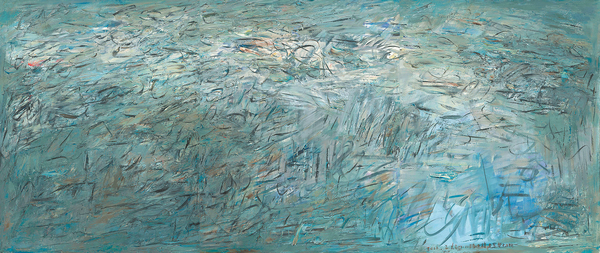
Zhao Dajun
Introduction
Zhao Dajun (1937-2023) was a renowned Chinese artist and educator, celebrated for his significant contributions to modern Chinese painting. Known for his transition from figurative to semi-abstract art, Zhao's work was deeply influenced by geometric patterns and the natural landscapes of the Xizang autonomous region. Throughout his career, Zhao exhibited a unique ability to transcend his own artistic achievements, continually reinventing himself and his style. His dedication to his craft, despite the challenges he faced, marks him as a key figure in the development of Chinese modernism in art.
Early Life
From an early age, he displayed a keen interest in art, which was nurtured by his surroundings and the cultural environment of the time. His formative years were marked by his enrollment at the Attached Secondary Art School of the Luxun Academy of Fine Arts in Shenyang, Liaoning province, in 1954. This institution played a pivotal role in shaping his artistic vision and technique, providing him with a solid foundation in the principles of fine arts. His early exposure to various art forms and the rich cultural heritage of his homeland deeply influenced his artistic path.
Education
Zhao's formal education began at the Luxun Academy of Fine Arts, where he was exposed to a broad curriculum that emphasized both traditional and contemporary art forms. This institution is renowned for its rigorous training and its role in nurturing some of China's most talented artists. During his time at the academy, Zhao honed his skills in oil painting, which became his lifelong passion. He was particularly influenced by the principles of cubism and the works of artists like Pablo Picasso and Paul Klee, which encouraged him to explore the deconstruction of forms into geometric patterns. This period of education laid the groundwork for his later artistic explorations and innovations.
Career
Initial Career
Zhao's career began with a strong foundation in realism, as he sought to capture the essence of his surroundings and experiences. His early works were characterized by a meticulous attention to detail and a commitment to portraying the truth of his subjects. However, over time, Zhao became increasingly drawn to the expressive potential of geometric abstraction, which allowed him to break free from the constraints of traditional forms. His initial career phase was marked by experimentation and a desire to forge a unique artistic identity, setting the stage for his later, more innovative works.
Major Works
One of Zhao's most significant contributions to the art world is the Sacred Mountains series. Conceived after he turned 60, this series marked a profound shift in his artistic approach, as he embraced semi-abstract styles inspired by the natural beauty of the Xizang autonomous region. The series reflects Zhao's deep connection to the landscapes he encountered on his travels, particularly the snowcapped mountains that captivated his imagination. Through the use of geometric patterns and a simplified brushwork, Zhao was able to convey the spirituality and grandeur of these natural wonders. His major works also include pieces like The Old Art School and The Smelter, which capture key moments and transformations in his life and the broader cultural landscape.
Achievements and Awards
Throughout his illustrious career, Zhao Dajun received numerous accolades for his contributions to the field of art. His work was celebrated for its innovation and its ability to transcend conventional artistic boundaries. Zhao's exhibitions, such as the Geometry exhibition at the Tsinghua University Art Museum, showcased his mastery of form and his unique artistic journey. His ability to continually reinvent himself and exceed his previous achievements earned him a respected place in the annals of modern Chinese art. Zhao's legacy is marked by the numerous awards and recognitions he received, reflecting his enduring impact on the art world.
Legacy and Influence
Zhao Dajun's legacy is characterized by his relentless pursuit of artistic excellence and his willingness to explore new frontiers in art. His innovative use of geometric patterns and his transition from realism to semi-abstraction have left a lasting mark on the development of modern Chinese painting. Zhao's ability to draw inspiration from diverse sources, including nature and music, and his commitment to breaking conventional rules, have inspired countless artists both in China and around the world. His work continues to be celebrated for its depth, creativity, and the profound insights it offers into the relationship between art and life. Zhao Dajun's influence extends beyond his paintings, as he has paved the way for future generations of artists to explore their own creative potential.








